This article examines the significant Go-to-Market (GTM) hurdles for medical technology (MedTech) startups operating in the DACH region, which includes Germany, Austria, and Switzerland. Market entry in this territory is heavily influenced by a rigorous regulatory framework consisting of the EU Medical Device Regulation (MDR), the In Vitro Diagnostic Regulation (IVDR), and the General Data Protection Regulation (GDPR). The research identifies that these startups often struggle with internal capacity to manage such multifaceted requirements, resulting in substantial product launch delays and heightened operational costs. For example, more than 70% of German MedTech startups have reported GTM delays specifically due to bottlenecks related to the MDR. The study highlights that the MDR, enforced since 2021, introduced stricter clinical evaluation needs and mandatory engagement with notified bodies, which has strained existing capacities and doubled review timelines in some instances. To navigate these challenges, the article explores the strategic integration of management technologies. This includes the use of regulatory information management systems, quality management software, and project management tools designed to improve the efficiency and effectiveness of GTM execution. A notable real-time use case utilizes Natural Language Processing (NLP) and Large Language Models (LLMs) to automate MDR documentation, reportedly reducing compliance preparation time by 70%. Ultimately, the research suggests that by embedding regulatory milestones directly into launch roadmaps and utilizing Regulatory Technology (RegTech) solutions, MedTech startups can transform compliance from a formidable barrier into a strategic competitive advantage within the DACH region.
This is an Open Access article, distributed under the terms of the Creative Commons Attribution 4.0 International License (http://creativecommons.org/licenses/by/4.0/), which permits unrestricted use, distribution and reproduction in any medium or format, provided the original work is properly cited.
The DACH region represents one of the most dynamic yet tightly regulated MedTech markets in the world. Germany alone accounts for over 25% of the European medical device market, with Austria and Switzerland contributing significantly through innovation and cross-border collaboration
. However, startups in this region face a formidable regulatory landscape shaped by the EU Medical Device Regulation (MDR), In Vitro Diagnostic Regulation (IVDR), and the General Data Protection Regulation (GDPR).
The MDR, enforced since May 2021, has redefined compliance expectations by introducing stricter clinical evaluation requirements, enhanced post-market surveillance, and mandatory engagement with notified bodies
[7]
European Commission. (2021). Medical Device Regulation (MDR).
. In Switzerland, although not an EU member, the Federal Office of Public Health (FOPH) has aligned its regulatory framework with MDR, creating additional complexity for cross-border startups
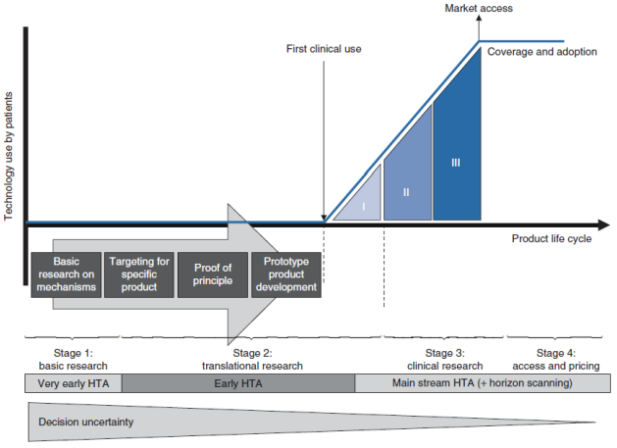
The medical technology lifecycle unfolds through distinct stages, each involving different levels of Health Technology Assessment (HTA). It starts with basic research (very early HTA), where entrepreneurs identify healthcare problems and conceptualize solutions amidst significant unknowns about market viability, efficacy, and health outcomes
[20]
Boni, A. A., & Abremski, D. (2022). Commercialization Challenges and Approaches for Digital Health Transformation. Journal of Commercial Biotechnology, 27(1).
Markiewicz, K., Van Til, J. A., Steuten, L. M., & IJzerman, M. J. (2016). Commercial viability of medical devices using Headroom and return on investment calculation. Technological Forecasting and Social Change, 112, 338–346.
. The next phase, translational research (early HTA), focuses on developing a proof-of-principle and a prototype, enabling more informed assumptions about the technology’s future despite lingering uncertainties. Following this, clinical trials rigorously test the technology’s safety and effectiveness. Upon successful completion, regulatory approval (e.g., CE mark) is sought. The final stage involves market entry and scaling through a well-developed business model (mainstream HTA), where prior cost-effectiveness estimates are validated with real-world data, and the technology’s value proposition is tailored to meet stakeholder demands
[15]
SPECTARIS, DIHK, & MedicalMountains. (2023). MDR-Umfrage 2023: Ergebnisse der gemeinsamen Umfrage von DIHK, MedicalMountains und SPECTARIS [MDR survey 2023: Results of the joint survey by DIHK, MedicalMountains and SPECTARIS].
The text highlights the problem "Startups often lack the internal capacity to manage these regulations," "delays in product launches and increased operational costs" but doesn't detail what specific strategies MedTech startups in DACH are employing to overcome these GTM compliance challenges. Even more crucially, it doesn't evaluate how effective these different strategies are
[10]
He, W., Baxter, G., & Xu, H. (2017). Regulatory challenges in medical device innovation. Journal of Medical Systems, 41(12), 1–10.
[10]
.
Startups often lack the internal capacity to manage these regulations, leading to delays in product launches and increased operational costs. According to Spectaris
[15]
SPECTARIS, DIHK, & MedicalMountains. (2023). MDR-Umfrage 2023: Ergebnisse der gemeinsamen Umfrage von DIHK, MedicalMountains und SPECTARIS [MDR survey 2023: Results of the joint survey by DIHK, MedicalMountains and SPECTARIS].
, over 70% of German MedTech startups reported GTM delays due to MDR-related bottlenecks, with similar trends observed in Austria and Switzerland.
The DACH region—comprising Germany, Austria, and Switzerland—represents one of the most dynamic yet tightly regulated MedTech markets in the world. Germany alone accounts for over 25 percent of the European medical device market, with Austria and Switzerland contributing significantly through innovation and cross-border collaboration
To evaluate the perceived effectiveness of different GTM strategies adopted by MedTech startups in the DACH region in mitigating compliance-related challenges from MDR, IVDR, and GDPR, exploring variations across device classifications and startup maturity.
Startups in this region face a formidable regulatory landscape shaped by three core frameworks: the EU Medical Device Regulation (MDR), the In Vitro Diagnostic Regulation (IVDR), and the General Data Protection Regulation (GDPR). The MDR, enforced since May 2021, has redefined compliance expectations by introducing stricter clinical evaluation requirements, enhanced post-market surveillance, and mandatory engagement with Notified Bodies for conformity assessment
[7]
European Commission. (2021). Medical Device Regulation (MDR).
Under MDR, devices are classified into four risk classes (I, IIa, IIb, III), each requiring a tailored conformity assessment by a Notified Body. A surge in applications has strained Notified Body capacity, often doubling review timelines. The introduction of a mandatory Unique Device Identification (UDI) system and the rollout of the EUDAMED database have added layers of administrative overhead for manufacturers and economic operators
[15]
SPECTARIS, DIHK, & MedicalMountains. (2023). MDR-Umfrage 2023: Ergebnisse der gemeinsamen Umfrage von DIHK, MedicalMountains und SPECTARIS [MDR survey 2023: Results of the joint survey by DIHK, MedicalMountains and SPECTARIS].
Digital health innovations face the dual challenge of MDR/IVDR compliance and stringent GDPR requirements for patient data. Startups must implement privacy-by-design principles, secure data storage, and breach notification processes. National variations—such as Switzerland’s Federal Act on Data Protection (FADP) and Germany’s Telemedia Act—further complicate a unified approach to cybersecurity and consent management
Market access pathways vary across the DACH region. Germany’s DiGA fast-track for health apps offers reimbursement under statutory health insurance, Austria relies on the Leistungserfassungs- und vergütungssystem (LKF) hospital financing system, and Switzerland uses its TARMED tariff framework. Navigating these divergent reimbursement landscapes requires tailored commercial strategies alongside regulatory approval
[1]
Austrian Business Agency. (2023). MedTech innovation in Austria: Regulatory pathways and startup support.
Startups often lack the internal capacity to manage these multifaceted requirements, leading to delays in product launches and increased operational costs. According to SPECTARIS et al.
[15]
SPECTARIS, DIHK, & MedicalMountains. (2023). MDR-Umfrage 2023: Ergebnisse der gemeinsamen Umfrage von DIHK, MedicalMountains und SPECTARIS [MDR survey 2023: Results of the joint survey by DIHK, MedicalMountains and SPECTARIS].
, over 70 percent of German MedTech startups reported go-to-market delays due to MDR-related bottlenecks, with similar trends observed in Austria and Switzerland.
1.4. Research Question
To identify and describe the specific Go-to-Market (GTM) strategies employed by MedTech startups in the DACH region to navigate MDR, IVDR, and GDPR compliance challenges, with a particular focus on the integration and utilization of management technologies (such as regulatory information management systems, quality management software, and project management tools) to enhance efficiency and effectiveness.
1.5. Relevance to Management Technology
"Integration and utilization of management technologies": This directly points to the research area.
"(such as regulatory information management systems, quality management software, project management tools)": These examples provide concrete types of management technologies that would be relevant in this context, guiding the research focus.
"To enhance efficiency and effectiveness": This clarifies why these technologies are relevant – they are used to improve how GTM and compliance are managed.
2. Core GTM Challenges and Strategic Planning in DACH Region
2.1. Regulatory Fragmentation and Interpretation
Regulatory fragmentation remains a central barrier for MedTech startups navigating the DACH region. Despite the harmonizing intent of MDR and IVDR, national competent authorities interpret key provisions—such as software as a medical device (SaMD) classification—through distinct lenses. In Germany, the BfArM has released supplementary guidance requiring granular risk assessments for SaMD, whereas Austria’s BASG encourages early-stage dialogue with notified bodies to preempt classification disputes
[3]
BfArM. (2023). Guidance on software classification under MDR.
. The divergence in practical applications extends beyond mere classification: it permeates expectations for clinical evidence, labeling language, and post-market vigilance procedures. Consequently, startups must maintain parallel compliance blueprints, adapting technical documentation and quality-management processes to satisfy each jurisdiction’s idiosyncrasies.
2.2. Talent Shortages and Resource Constraints
Human capital deficits in regulatory affairs amplify the complexity of GTM planning. A recent MedTech Europe survey found that 68% of German and Austrian startups lack dedicated in-house compliance teams, forcing reliance on external consultants with steep hourly rates and variable domain expertise
[12]
MedTech Europe. (2023). Startup challenges in EU compliance.
. Beyond cost pressures, this outsourcing model introduces latency in decision-making: third-party advisors must first familiarize themselves with the product’s underlying science, market positioning, and development strategy. Academic research corroborates that firms with embedded regulatory specialists accelerate certification processes by up to 30%, underscoring the value of internal capacity-building
[16]
MDR transition period and certification bottleneck | ICON plc. (2022). ICON Plc.
The scarcity of MDR-designated notified bodies in Germany and Austria has translated into protracted conformity-assessment backlogs, with some timelines extending beyond 12 months
[32]
EU-Startups. (2025). Navigating regulatory hurdles: A startup’s guide to compliance in complex industries.
[32]
. Swiss manufacturers, no longer covered by pre-MDR mutual-recognition agreements, confront parallel audits for EU and Swiss market entry—often duplicating technical-file reviews and clinical-evaluation reports
[7]
European Commission. (2021). Medical Device Regulation (MDR).
. Academic analyses reveal that notified-body capacity constraints correlate strongly with device risk class: higher-risk (Class IIb/III) submissions experience average delays 40% longer than Class I/IIa products
[17]
Dobrzynska, A., Rejon-Parrilla, J. C., Epstein, D., Aranda-López, J., Fraser, A. G., & Blasco-Amaro, J. A. (2025). Survey of Notified Bodies reveals very limited use of conditional certification for high-risk medical devices. Frontiers in Medical Technology, 7, 1504294.
Startups integrating AI algorithms and remote-monitoring platforms face a dual-compliance dilemma: stringent GDPR requirements for patient consent and data security, plus national mandates for onshore data residency. Germany’s Telemedia Act and Switzerland’s FADP impose explicit localization rules, requiring health-data storage on servers physically located within national borders
[18]
O’Brien, D. (2019). European Medical Device Regulation (MDR) for MedTech and medical device manufacturers.
[19]
European Data Protection Board. (2023). Data protection guide for small businesses.
. This compartmentalization complicates cloud-native solutions, escalating infrastructure investments and mandating multi-jurisdictional privacy-impact assessments. Comparative studies indicate that companies adopting privacy-by-design frameworks reduce breach incidents by 25%, illustrating the long-term benefits of proactive data governance
[20]
Boni, A. A., & Abremski, D. (2022). Commercialization Challenges and Approaches for Digital Health Transformation. Journal of Commercial Biotechnology, 27(1).
Robust TAM, SAM, and SOM analyses underpin sound GTM strategies in DACH. Literature highlights the importance of granular segmentation, differentiating hospital systems from ambulatory-care networks and distinguishing public-payer reimbursement tracks from private-insurer models
[21]
Frost & Sullivan. (2022). Analysis of the DACH medical device market: Growth opportunities and go-to-market strategies. Frost & Sullivan Store.
[21]
. Moreover, regulatory risk‐class overlays guide prioritization: low-risk devices often achieve faster market uptake, freeing resources to invest in higher-risk, higher-reward products. Case studies from Eucomed emphasize that dynamic segmentation continually refreshed with real-world data yields more accurate sales forecasts and identifies underserved clinical niches.
2.6. Value Proposition, Positioning, and Pricing
A compelling value narrative in DACH markets marries clinical efficacy with cost-savings and workflow optimization. Research shows that payers and hospital procurement officers prioritize evidence of reduced length-of-stay and lower total-cost-of-care metrics
[22]
Varnosfaderani, S. M., & Forouzanfar, M. (2024). The role of AI in Hospitals and Clinics: Transforming Healthcare in the 21st century. Bioengineering, 11(4), 337.
. Tailored messaging—aligned with Germany’s DiGA fast-track, Austria’s LKF hospital financing, and Switzerland’s TARMED tariff negotiations—reinforces local relevance. Health-economic modeling, when substantiated by robust cost-utility analyses, speeds reimbursement approvals by demonstrating clear return on investment for each stakeholder group
[1]
Austrian Business Agency. (2023). MedTech innovation in Austria: Regulatory pathways and startup support.
2.7. Integrating Compliance Milestones into GTM Timelines
Embedding regulatory milestones into launch roadmaps transforms compliance from a blocker into a strategic enabler. Best practices recommend Gantt charts that layer MDR/IVDR conformity assessments, clinical study timelines, PMCF requirements, and EUDAMED UDI registrations
[23]
PricewaterhouseCoopers. (2022). Medical Device Regulation (MDR) and In Vitro Diagnostic Regulation (IVDR): Navigating the new landscape.
. Assigning RACI matrices ensures accountability across regulatory affairs, quality, R&D, and commercial teams. Empirical evidence suggests that projects with integrated milestone tracking achieve 20% fewer schedule overruns and reduce ad-hoc regulatory queries by fostering transparent progress reporting.
2.8. Distribution and Partnership Management
Choosing the right distribution model hinges on a partner’s regulatory expertise, market footprint, and service capabilities. Literature on channel strategy in regulated industries emphasizes that distributors with deep notified-body relationships and local‐language labeling proficiency accelerate market entry
[29]
Medical Valley EMN. (2021). Market access and distribution strategies for MedTech in Germany. Medical Valley Bavaria Industry Reports.
. Collaboration with academic centers, innovation hubs, and KOL networks for pilot studies not only bolsters clinical credibility but also paves the way for early adoption and smoother reimbursement negotiations.
2.9. Success Metrics, Continuous Feedback, and Risk Mitigation
Defining leading and lagging indicators is critical for sustained GTM success. Leading metrics such as regulatory milestone completion rates, notified‐body engagement frequency, and early pilot site activations signal readiness for scale. Lagging indicators: first sales, reimbursement approval times, and market share relative to incumbents- measure ultimate commercial success. Establishing voice-of-customer loops during PMCF and iteratively incorporating field-feedback closes the gap between product design and real-world performance, mitigating downstream risk and informing next-generation device improvements.
3. Real-Time Use Cases from the DACH Region
3.1. Cool AI (Germany): Automating MDR Compliance
Cool AI, a Munich-based startup, developed a RegTech platform that automates MDR documentation using NLP and large language models
[4]
Brown, T., Mann, B., Ryder, N., et al. (2020). Language models are few-shot learners. Advances in Neural Information Processing Systems, 33, 1877–1901.
[4]
. By integrating with ERP systems and offering multilingual support, Cool AI reduced compliance preparation time by 70% for early-stage MedTech firms
[24]
Rahman, A. H. (2025). Business Case of Cool AI: Feasibility Study of Regulatory Compliance Automation in DACH Medical Technology Businesses. SSRN.
. Their collaboration with BfArM helped refine their algorithms to meet German-specific regulatory nuances.
Cool AI’s success illustrates the potential of AI-driven compliance tools in overcoming GTM delays. Their phased rollout, starting with German clients and expanding to Austria, demonstrates strategic localization in a fragmented regulatory environment
[24]
Rahman, A. H. (2025). Business Case of Cool AI: Feasibility Study of Regulatory Compliance Automation in DACH Medical Technology Businesses. SSRN.
Davenport, T. H., & Ronanki, R. (2018). Artificial intelligence for the real world. Harvard Business Review, 96(1), 108-116.
[24, 31]
.
3.2. CardioTrack (Austria): Navigating IVDR for Diagnostic Wearables
CardioTrack, a Vienna-based startup, developed a wearable ECG monitor classified under IVDR. Initially categorized as Class B, the device was reclassified as Class C due to its diagnostic capabilities, requiring more rigorous clinical validation. The startup partnered with the Medical University of Vienna to conduct trials and engaged early with Austria’s BASG to streamline approval
[1]
Austrian Business Agency. (2023). MedTech innovation in Austria: Regulatory pathways and startup support.
This case highlights the importance of academic partnerships and proactive regulatory engagement in Austria’s MedTech ecosystem.
3.3. NeuroSense (Switzerland): GDPR and Cross-Border Data Challenges
NeuroSense, a Zurich-based startup, developed a neurofeedback device that collects real-time brainwave data. Their initial cloud infrastructure stored data in Germany, triggering compliance concerns under Swiss data protection laws. After consultation with Swiss MedTech and FOPH, the company migrated to a Swiss-based cloud provider and implemented privacy-by-design protocols
[25]
Swiss Medtech. (2023). MDR portal: News and updates on the Medical Device Regulation.
NeuroSense’s experience underscores the importance of aligning data governance with national regulations, especially in Switzerland’s post-MDR landscape.
4. Strategic Solutions for DACH Startups
4.1. RegTech Adoption and Localization
Platforms like Cool AI are increasingly vital for startups in the DACH region. By automating documentation and offering jurisdiction-specific guidance, RegTech tools reduce compliance friction
[2]
Benlian, A., Koufaris, M., & Hess, T. (2011). Service quality in software-as-a-service: Developing the SaaS-quality scale. Journal of Service Research, 14(3), 243–260.
[2]
. Startups should prioritize platforms that support German, Austrian, and Swiss regulatory nuances
[11]
Market Data Forecast. (2021). RegTech market forecast 2021–2026.
Investing in regulatory talent is essential. DACH startups are partnered with universities such as TU Munich and ETH Zurich to develop training programs in regulatory science. These collaborations help build long-term internal capacity and reduce reliance on external consultants
[27]
Reichstein, T., Salter, A. J., & Gann, D. M. (2008). Breakthrough innovation and the dynamics of knowledge accumulation: The case of pharmaceutical R&D. Research Policy, 37(1), 129-140.
[27]
.
4.3. Early Engagement with Authorities
Startups should engage early with BfArM, BASG, and FOPH to clarify classification and documentation expectations. Regulatory sandboxes, such as those piloted in Austria, offer controlled environments for testing innovative devices
[13]
MedTech Views. (2017). The challenges of a MedTech startup in the land of scattered Regulatory Information.
GDPR and national data laws require robust data governance. Startups must implement encryption, consent management, and localized data storage. Partnering with compliant cloud providers in the DACH region ensures smoother GTM execution
[6]
Clarke, R., & Fischer, M. (2022). Data protection in digital health: GDPR and beyond. Health Informatics Journal, 28(1), 45–60.
[28]
Vardas, E. P., Marketou, M., & Vardas, P. E. (2025). Medicine, healthcare and the AI act: gaps, challenges and future implications. European Heart Journal - Digital Health, 6(4), 833–839.
5. Conclusion and Outlook for DACH MedTech Startups
The DACH region offers immense opportunities for MedTech innovation, but startups must navigate a dense regulatory landscape to succeed. MDR, IVDR, GDPR, and the EU AI Act present overlapping challenges that require strategic planning, technological adaptation, and localized expertise
[8]
European Commission. (2025). EU AI Act: Regulation of Artificial Intelligence.
Real-time use cases from Germany, Austria, and Switzerland reveal the importance of RegTech, academic partnerships, and proactive engagement with regulators. As the regulatory environment continues to evolve, startups must adopt a compliance-first mindset and leverage emerging tools to accelerate their GTM journey.
Looking ahead, the integration of explainable AI, predictive analytics, and cross-border regulatory harmonization will shape the future of MedTech in the DACH region. With the right strategies, startups can transform compliance from a barrier into a competitive advantage.
Benlian, A., Koufaris, M., & Hess, T. (2011). Service quality in software-as-a-service: Developing the SaaS-quality scale. Journal of Service Research, 14(3), 243–260.
[3]
BfArM. (2023). Guidance on software classification under MDR.
Brown, T., Mann, B., Ryder, N., et al. (2020). Language models are few-shot learners. Advances in Neural Information Processing Systems, 33, 1877–1901.
SPECTARIS, DIHK, & MedicalMountains. (2023). MDR-Umfrage 2023: Ergebnisse der gemeinsamen Umfrage von DIHK, MedicalMountains und SPECTARIS [MDR survey 2023: Results of the joint survey by DIHK, MedicalMountains and SPECTARIS].
Dobrzynska, A., Rejon-Parrilla, J. C., Epstein, D., Aranda-López, J., Fraser, A. G., & Blasco-Amaro, J. A. (2025). Survey of Notified Bodies reveals very limited use of conditional certification for high-risk medical devices. Frontiers in Medical Technology, 7, 1504294.
Boni, A. A., & Abremski, D. (2022). Commercialization Challenges and Approaches for Digital Health Transformation. Journal of Commercial Biotechnology, 27(1).
Frost & Sullivan. (2022). Analysis of the DACH medical device market: Growth opportunities and go-to-market strategies. Frost & Sullivan Store.
[22]
Varnosfaderani, S. M., & Forouzanfar, M. (2024). The role of AI in Hospitals and Clinics: Transforming Healthcare in the 21st century. Bioengineering, 11(4), 337.
Reichstein, T., Salter, A. J., & Gann, D. M. (2008). Breakthrough innovation and the dynamics of knowledge accumulation: The case of pharmaceutical R&D. Research Policy, 37(1), 129-140.
[28]
Vardas, E. P., Marketou, M., & Vardas, P. E. (2025). Medicine, healthcare and the AI act: gaps, challenges and future implications. European Heart Journal - Digital Health, 6(4), 833–839.
Davenport, T. H., & Ronanki, R. (2018). Artificial intelligence for the real world. Harvard Business Review, 96(1), 108-116.
[32]
EU-Startups. (2025). Navigating regulatory hurdles: A startup’s guide to compliance in complex industries.
[33]
Markiewicz, K., Van Til, J. A., Steuten, L. M., & IJzerman, M. J. (2016). Commercial viability of medical devices using Headroom and return on investment calculation. Technological Forecasting and Social Change, 112, 338–346.
Rahman, A. Y. M. H. (2026). Navigating Regulatory Compliance in Go-to-Market Strategies for MedTech Startups in the DACH Region. American Journal of Medical Science and Technology, 2(2), 25-31. https://doi.org/10.11648/j.ajmst.20260202.12
Rahman, A. Y. M. H. Navigating Regulatory Compliance in Go-to-Market Strategies for MedTech Startups in the DACH Region. Am. J. Med. Sci. Technol.2026, 2(2), 25-31. doi: 10.11648/j.ajmst.20260202.12
Rahman AYMH. Navigating Regulatory Compliance in Go-to-Market Strategies for MedTech Startups in the DACH Region. Am J Med Sci Technol. 2026;2(2):25-31. doi: 10.11648/j.ajmst.20260202.12
@article{10.11648/j.ajmst.20260202.12,
  author = {Abu Yusuf Mohammad Habibur Rahman},
  title = {Navigating Regulatory Compliance in Go-to-Market Strategies for MedTech Startups in the DACH Region},
  journal = {American Journal of Medical Science and Technology},
  volume = {2},
  number = {2},
  pages = {25-31},
  doi = {10.11648/j.ajmst.20260202.12},
  url = {https://doi.org/10.11648/j.ajmst.20260202.12},
  eprint = {https://article.sciencepublishinggroup.com/pdf/10.11648.j.ajmst.20260202.12},
  abstract = {This article examines the significant Go-to-Market (GTM) hurdles for medical technology (MedTech) startups operating in the DACH region, which includes Germany, Austria, and Switzerland. Market entry in this territory is heavily influenced by a rigorous regulatory framework consisting of the EU Medical Device Regulation (MDR), the In Vitro Diagnostic Regulation (IVDR), and the General Data Protection Regulation (GDPR). The research identifies that these startups often struggle with internal capacity to manage such multifaceted requirements, resulting in substantial product launch delays and heightened operational costs. For example, more than 70% of German MedTech startups have reported GTM delays specifically due to bottlenecks related to the MDR. The study highlights that the MDR, enforced since 2021, introduced stricter clinical evaluation needs and mandatory engagement with notified bodies, which has strained existing capacities and doubled review timelines in some instances. To navigate these challenges, the article explores the strategic integration of management technologies. This includes the use of regulatory information management systems, quality management software, and project management tools designed to improve the efficiency and effectiveness of GTM execution. A notable real-time use case utilizes Natural Language Processing (NLP) and Large Language Models (LLMs) to automate MDR documentation, reportedly reducing compliance preparation time by 70%. Ultimately, the research suggests that by embedding regulatory milestones directly into launch roadmaps and utilizing Regulatory Technology (RegTech) solutions, MedTech startups can transform compliance from a formidable barrier into a strategic competitive advantage within the DACH region.},
 year = {2026}
}
TY  - JOUR
T1  - Navigating Regulatory Compliance in Go-to-Market Strategies for MedTech Startups in the DACH Region
AU  - Abu Yusuf Mohammad Habibur Rahman
Y1  - 2026/03/10
PY  - 2026
N1  - https://doi.org/10.11648/j.ajmst.20260202.12
DO  - 10.11648/j.ajmst.20260202.12
T2  - American Journal of Medical Science and Technology
JF  - American Journal of Medical Science and Technology
JO  - American Journal of Medical Science and Technology
SP  - 25
EP  - 31
PB  - Science Publishing Group
UR  - https://doi.org/10.11648/j.ajmst.20260202.12
AB  - This article examines the significant Go-to-Market (GTM) hurdles for medical technology (MedTech) startups operating in the DACH region, which includes Germany, Austria, and Switzerland. Market entry in this territory is heavily influenced by a rigorous regulatory framework consisting of the EU Medical Device Regulation (MDR), the In Vitro Diagnostic Regulation (IVDR), and the General Data Protection Regulation (GDPR). The research identifies that these startups often struggle with internal capacity to manage such multifaceted requirements, resulting in substantial product launch delays and heightened operational costs. For example, more than 70% of German MedTech startups have reported GTM delays specifically due to bottlenecks related to the MDR. The study highlights that the MDR, enforced since 2021, introduced stricter clinical evaluation needs and mandatory engagement with notified bodies, which has strained existing capacities and doubled review timelines in some instances. To navigate these challenges, the article explores the strategic integration of management technologies. This includes the use of regulatory information management systems, quality management software, and project management tools designed to improve the efficiency and effectiveness of GTM execution. A notable real-time use case utilizes Natural Language Processing (NLP) and Large Language Models (LLMs) to automate MDR documentation, reportedly reducing compliance preparation time by 70%. Ultimately, the research suggests that by embedding regulatory milestones directly into launch roadmaps and utilizing Regulatory Technology (RegTech) solutions, MedTech startups can transform compliance from a formidable barrier into a strategic competitive advantage within the DACH region.
VL  - 2
IS  - 2
ER  -
Rahman, A. Y. M. H. (2026). Navigating Regulatory Compliance in Go-to-Market Strategies for MedTech Startups in the DACH Region. American Journal of Medical Science and Technology, 2(2), 25-31. https://doi.org/10.11648/j.ajmst.20260202.12
Rahman, A. Y. M. H. Navigating Regulatory Compliance in Go-to-Market Strategies for MedTech Startups in the DACH Region. Am. J. Med. Sci. Technol.2026, 2(2), 25-31. doi: 10.11648/j.ajmst.20260202.12
Rahman AYMH. Navigating Regulatory Compliance in Go-to-Market Strategies for MedTech Startups in the DACH Region. Am J Med Sci Technol. 2026;2(2):25-31. doi: 10.11648/j.ajmst.20260202.12
@article{10.11648/j.ajmst.20260202.12,
  author = {Abu Yusuf Mohammad Habibur Rahman},
  title = {Navigating Regulatory Compliance in Go-to-Market Strategies for MedTech Startups in the DACH Region},
  journal = {American Journal of Medical Science and Technology},
  volume = {2},
  number = {2},
  pages = {25-31},
  doi = {10.11648/j.ajmst.20260202.12},
  url = {https://doi.org/10.11648/j.ajmst.20260202.12},
  eprint = {https://article.sciencepublishinggroup.com/pdf/10.11648.j.ajmst.20260202.12},
  abstract = {This article examines the significant Go-to-Market (GTM) hurdles for medical technology (MedTech) startups operating in the DACH region, which includes Germany, Austria, and Switzerland. Market entry in this territory is heavily influenced by a rigorous regulatory framework consisting of the EU Medical Device Regulation (MDR), the In Vitro Diagnostic Regulation (IVDR), and the General Data Protection Regulation (GDPR). The research identifies that these startups often struggle with internal capacity to manage such multifaceted requirements, resulting in substantial product launch delays and heightened operational costs. For example, more than 70% of German MedTech startups have reported GTM delays specifically due to bottlenecks related to the MDR. The study highlights that the MDR, enforced since 2021, introduced stricter clinical evaluation needs and mandatory engagement with notified bodies, which has strained existing capacities and doubled review timelines in some instances. To navigate these challenges, the article explores the strategic integration of management technologies. This includes the use of regulatory information management systems, quality management software, and project management tools designed to improve the efficiency and effectiveness of GTM execution. A notable real-time use case utilizes Natural Language Processing (NLP) and Large Language Models (LLMs) to automate MDR documentation, reportedly reducing compliance preparation time by 70%. Ultimately, the research suggests that by embedding regulatory milestones directly into launch roadmaps and utilizing Regulatory Technology (RegTech) solutions, MedTech startups can transform compliance from a formidable barrier into a strategic competitive advantage within the DACH region.},
 year = {2026}
}
TY  - JOUR
T1  - Navigating Regulatory Compliance in Go-to-Market Strategies for MedTech Startups in the DACH Region
AU  - Abu Yusuf Mohammad Habibur Rahman
Y1  - 2026/03/10
PY  - 2026
N1  - https://doi.org/10.11648/j.ajmst.20260202.12
DO  - 10.11648/j.ajmst.20260202.12
T2  - American Journal of Medical Science and Technology
JF  - American Journal of Medical Science and Technology
JO  - American Journal of Medical Science and Technology
SP  - 25
EP  - 31
PB  - Science Publishing Group
UR  - https://doi.org/10.11648/j.ajmst.20260202.12
AB  - This article examines the significant Go-to-Market (GTM) hurdles for medical technology (MedTech) startups operating in the DACH region, which includes Germany, Austria, and Switzerland. Market entry in this territory is heavily influenced by a rigorous regulatory framework consisting of the EU Medical Device Regulation (MDR), the In Vitro Diagnostic Regulation (IVDR), and the General Data Protection Regulation (GDPR). The research identifies that these startups often struggle with internal capacity to manage such multifaceted requirements, resulting in substantial product launch delays and heightened operational costs. For example, more than 70% of German MedTech startups have reported GTM delays specifically due to bottlenecks related to the MDR. The study highlights that the MDR, enforced since 2021, introduced stricter clinical evaluation needs and mandatory engagement with notified bodies, which has strained existing capacities and doubled review timelines in some instances. To navigate these challenges, the article explores the strategic integration of management technologies. This includes the use of regulatory information management systems, quality management software, and project management tools designed to improve the efficiency and effectiveness of GTM execution. A notable real-time use case utilizes Natural Language Processing (NLP) and Large Language Models (LLMs) to automate MDR documentation, reportedly reducing compliance preparation time by 70%. Ultimately, the research suggests that by embedding regulatory milestones directly into launch roadmaps and utilizing Regulatory Technology (RegTech) solutions, MedTech startups can transform compliance from a formidable barrier into a strategic competitive advantage within the DACH region.
VL  - 2
IS  - 2
ER  -





 Share This Article
 Twitter
 Linked In
 Facebook
 Copy
Copy Download